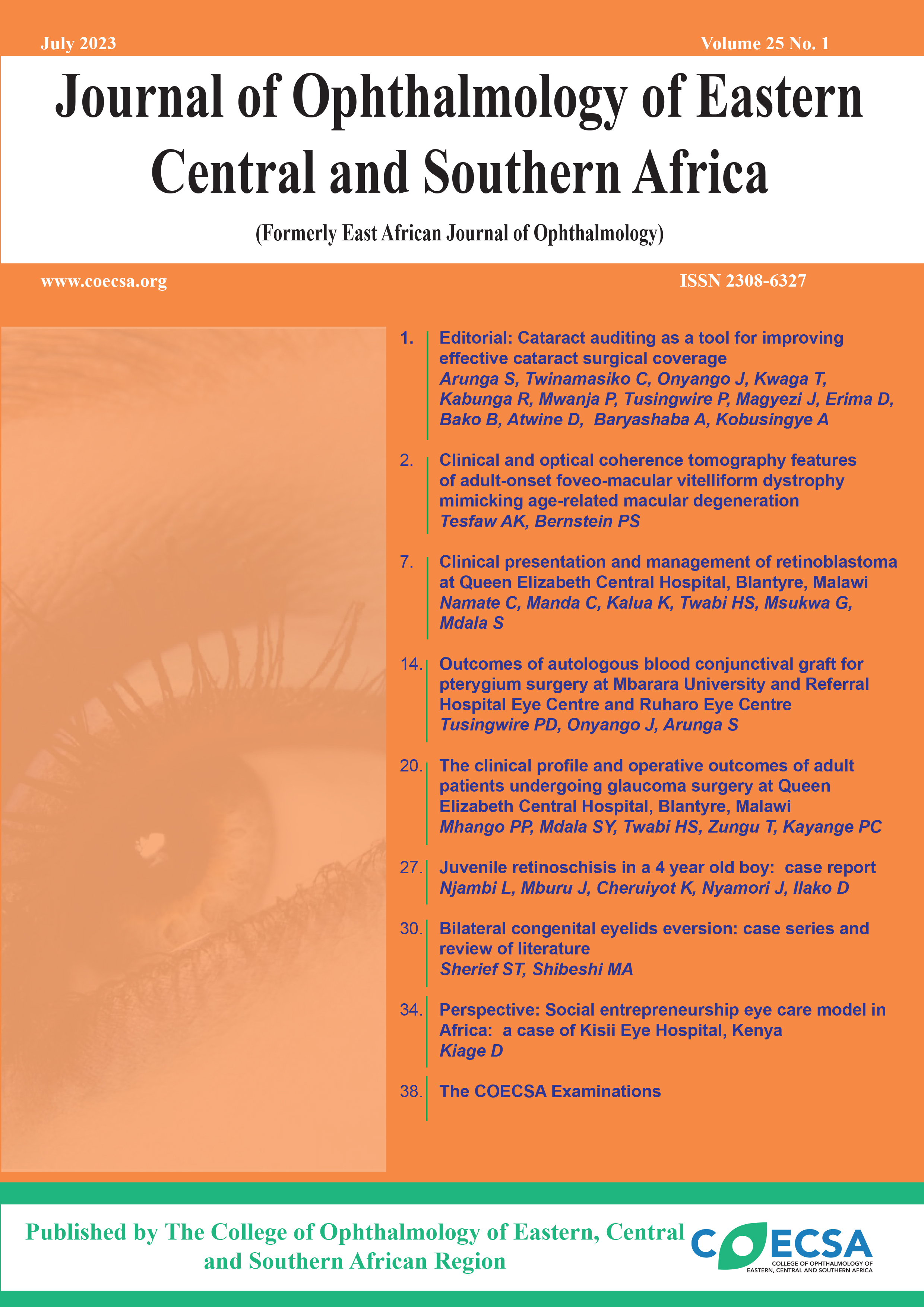
Editorial: Cataract auditing as a tool for improving effective cataract surgical coverage
DOI:
https://doi.org/10.64666/joecsa.2023.91Abstract
Globally, there is an estimated 216.6 million people with visual impairment (80% uncertainty interval [UI] 98.5- 395.1 million)1. Of these, 39 million people are blind (80% UI 12.9-65.4 million)1. Cataract is the leading cause of blindness globally, affecting approximately 12.6 million people in 2015 (80% UI 3.4–28.7)1. Cataract is also the cause of one quarter of moderate and severe vision impairment, affecting an estimated 52.6 million people (80% UI 18.2–109.6)1. Cataract surgery is the only definitive management for cataract with an estimated 25 million surgical cases per year. It is a highly effective sight restoration intervention.
There are several measures used to monitor the effectiveness of cataract surgery such as cataract surgical rate, cataract surgical coverage, sight restoration rate and others. In 2017, the concept of effective cataract surgical coverage started to take shape. This refers to proportion of people aged 50 years or older with operated cataract or operable cataract who have a good postoperative presenting visual acuity of 6/18 or better. According to the Lancet Global Health Commission on Global Eye Health: beyond vision 2020, the median effective cataract
surgical coverage for 48 countries was less than 50% for an outcome of 6/18 or better and an operable cataract threshold of worse than 6/60 between 2000-2019. This would be much less than the WHO recommended target of 80%. Much of the skewing towards the worse outcomes was in Sub Saharan Africa (SSA).
Downloads
Published
How to Cite
Issue
Section
Categories
License
Copyright (c) 2026 Dr.Arunga Simon, Dr.John Onyango, Dr.Teddy Kwaga, Dr.Rachel R. Kabunga, Dr.Mwanja Pius, Dr.Tusingwire Pliers Denis, Magyezi Joseph, Dr.Erima Denis, Dr.Bako Beatrice , Dr.Atwine Daniel , Baryashaba Amos, Kobusingye Annette , Twinamasiko Collins

This work is licensed under a Creative Commons Attribution 4.0 International License.
JOECSA publishes all content Open Access under the Creative Commons Attribution 4.0 International License (CC BY 4.0). Authors retain copyright. Anyone may share and adapt the work for any purpose, provided appropriate credit is given to the original author(s) and the source. License: https://creativecommons.org/licenses/by/4.0/