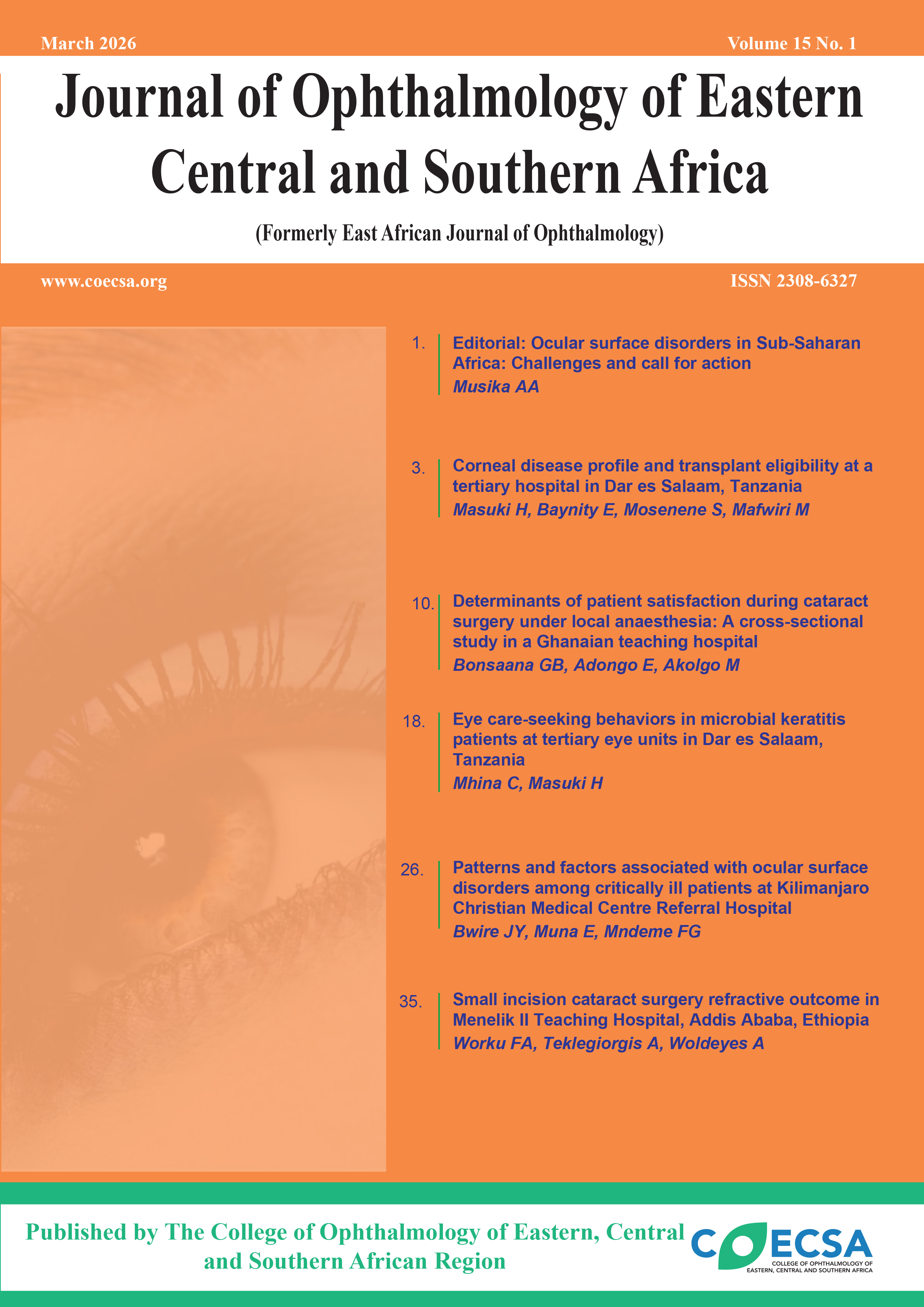
Eye Care-Seeking Behaviors in Microbial Keratitis Patients at Tertiary Eye Units in Dar es Salaam, Tanzania
DOI:
https://doi.org/10.64666/joecsa.2026.13Keywords:
Microbial keratitis, Eye healthcare-seeking behavior, Tertiary hospitals, TanzaniaAbstract
Objective. To investigate eye care–seeking behavior and associated factors among patients with microbial keratitis (MK) at two tertiary eye hospitals in Dar es Salaam, Tanzania.
Methods
We conducted a hospital-based cross-sectional study over six months at Muhimbili National Hospital and Comprehensive Community-Based Rehabilitation Tanzania Hospital. Consecutively recruited participants were interviewed using a structured questionnaire covering demographics, symptom duration, time to treatment, prior actions before presentation, and awareness of MK complications. Appropriate healthcare-seeking was defined as presenting to a formal health facility within 48 hours of symptom onset without prior self-treatment. Data were analyzed in SPSS v23, and multivariate logistic regression identified predictors of healthcare-seeking behavior.
Results:
A total of 351 participants were included, slightly more males (183, 52.1%). Most (221, 63%) were aged 18–40 years (mean 37 ± 16.6). Over one-third (135, 38.5%) were petty traders, and 213 (61%) lacked health insurance. Clinically, more than half (196, 55.8%) presented with severe MK, while 278 (79.2%) were unaware of its vision-threatening potential. Only 25% demonstrated appropriate healthcare-seeking behavior. Initial care locations were health facilities (42.7%), medical shops (32.2%), traditional healers (13.1%), and prayer houses (2.6%). Independent predictors of inappropriate behavior were lack of health insurance (aOR 1.30, 95% CI 1.09–1.53), being a petty trader (aOR 1.37, 95% CI 1.02–1.85), and lack of awareness of disease consequences (aOR 2.79, 95% CI 1.71–4.56).
Conclusions:
Only three in ten MK patients appropriately sought care. Inappropriate care-seeking was linked to occupation, lack of insurance, and poor awareness. Strengthening primary eye care, expanding insurance, and targeted education may improve outcomes.
Downloads
Published
How to Cite
Issue
Section
Categories
License
Copyright (c) 2026 Celina Mhina, Heavenlight masuki

This work is licensed under a Creative Commons Attribution 4.0 International License.
JOECSA publishes all content Open Access under the Creative Commons Attribution 4.0 International License (CC BY 4.0). Authors retain copyright. Anyone may share and adapt the work for any purpose, provided appropriate credit is given to the original author(s) and the source. License: https://creativecommons.org/licenses/by/4.0/